Most HR organisations today are analysing the impact of AI by looking at its impact on job levels. HR typically focuses on which tasks will disappear, which skills will become more important, and what this will mean for our employees. This feels logical. But if you are only looking at the job level, you might be missing the real impact of AI in your organisation.
To truly understand the impact of AI, we advocate for two things. 1) Look at the AI impact across multiple layers of the organisation, such as team, end-to-end services, organisational unit, and the organisation level. 2) Ask yourself who ultimately is best positioned to perform the work enhanced by AI: your organisation, another (new) organisation, or even the customer itself?
1. AI Impact across layers
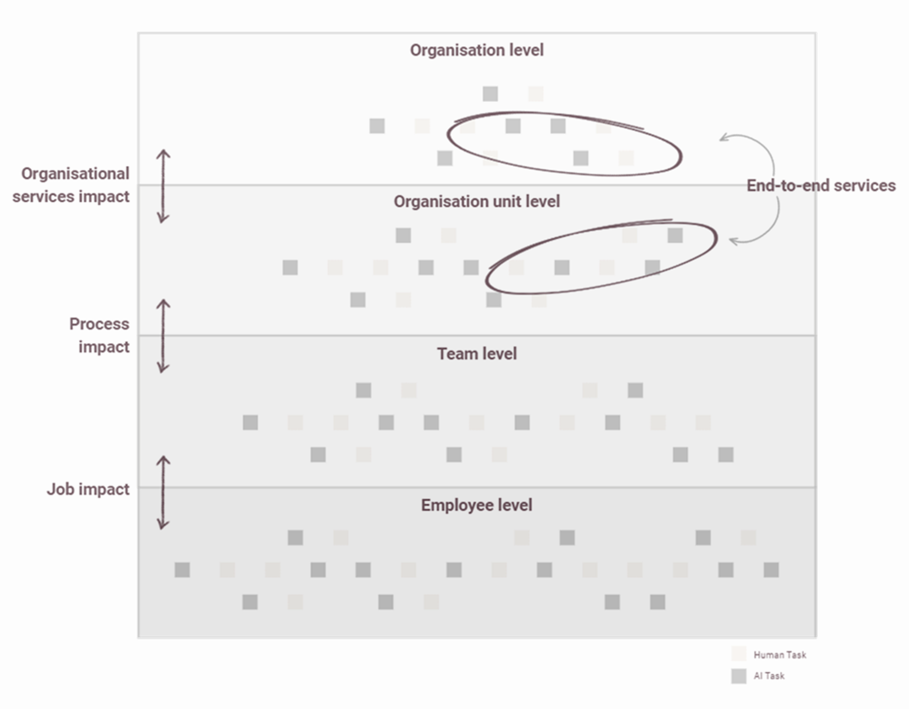
The impact of AI is not confined to the job role level, but can have a direct and indirect impact on the team, end-to-end services, and entire business unit levels. If AI affects one layer, the impact can cascade to others. This means that analysing work only at the role level will always miss the bigger picture.
At the employee level, some tasks disappear while new ones emerge. At the team level, AI can fundamentally change how work is coordinated and delivered. At the end‑to‑end process level, entire processes may be executed largely or even fully by AI. Each of these shifts can cascade both upward and downward, affecting the levels above and below. This means the impact of AI should be analysed simultaneously on all levels to understand the full systemic effect.
The impact of AI should be analysed on multiple levels in your organisation.
Take recruitment as an example. If AI significantly reshapes the end‑to‑end recruitment process, the impact is felt across multiple levels. At the employee level, the key question becomes which tasks should still be performed by humans. At the team level, it raises questions about whether the current distribution of work and handovers still makes sense. And at the HR level, it challenges whether a standalone Recruitment function is still needed at all.
If HR truly wants to be a strategic partner in defining the impact of AI on the workforce, it needs to move beyond discussions about roles and skills and engage in more strategic conversations about target operating models, services, and value creation itself, together with strategy and senior leadership.
2. Who is best positioned to do the work
Once you take that broader perspective, a second, more uncomfortable question emerges. If AI can reshape whole services or capabilities, is your organisation still best-positioned to deliver them?
AI is not just another wave of automation; it is lowering the barriers to entry across industries. Building software has become faster and cheaper. Interfaces and knowledge layers are easier to design. Integration via APIs is increasingly seamless. Even customers themselves can now create, for example, through low-code environments, services that were previously only possible to create within organisations. As a result, processes that once formed unique core capabilities of an organisation can now be replicated, or bypassed, by new entrants or even by end users.
Is your organisation still best-positioned to deliver your key services and capabilities?
This leads to a fundamentally different question. Not how we optimise the work, but whether this work will still exist within our organisation at all. This can fundamentally reshape end-to-end services, teams and roles. As a result, HR needs to engage in more strategic discussions about the organisation’s business models and the associated impact on the workforce.
Take online shopping as another example. Many e-commerce companies today operate with a clear front-end and back-end: an app or website where customers browse and buy, and a warehouse and logistics operation that fulfils the order. What happens if customers increasingly use AI to do their shopping for them? Not through your app, but via their preferred AI assistant, whether that is ChatGPT, a third-party overlay, or even their own personal agent that can compare options, place orders, and manage deliveries. In that world, the front-end becomes far less relevant. Customers no longer interact directly with your interface. The demand shifts from building the best app to ensuring your services are accessible and preferred by AI agents. This raises a critical question: what is the role of your front-end developers, product teams, and digital experience functions if the primary customer interface is no longer yours?
The strategic role of HR related to AI
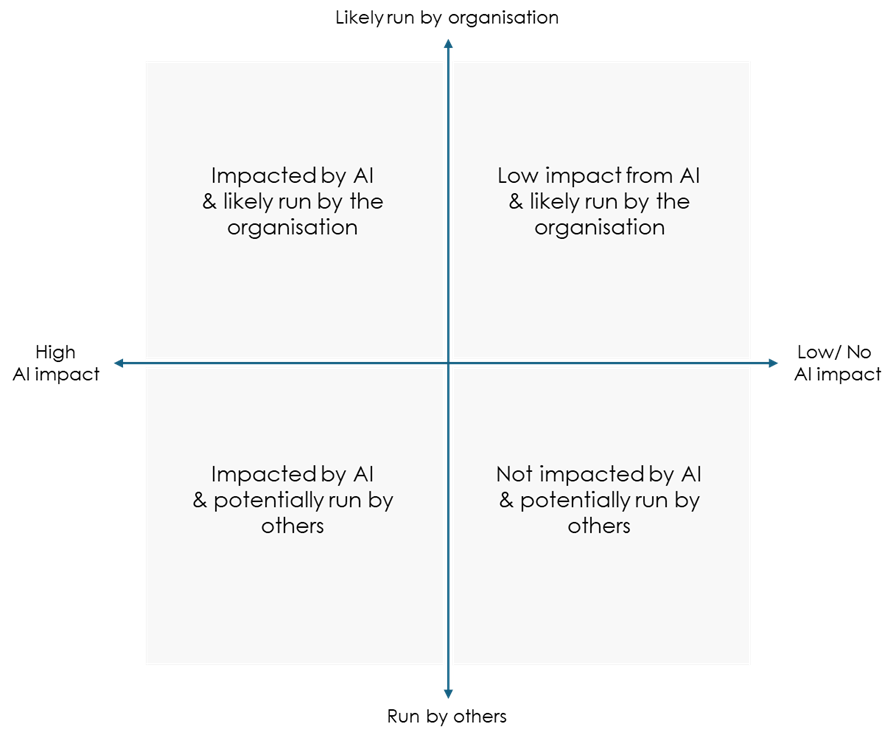
The real strategic insight emerges when these two perspectives are combined: understanding the impact of AI across all organisational levels, while also assessing which services and processes remain defensible in a world where entry barriers are rapidly declining.
A useful exercise is to map all tasks, roles, and end-to-end services in your organisation across two dimensions: first, the extent to which AI can perform this work, and second, the likelihood that this capability will shift outside your organisation, for example, to new entrants or even to customers themselves.
Strategic Workforce Management becomes the critical anchor. It is the mechanism through which HR connects these two perspectives. Not by looking at tasks and roles in isolation, but by translating organisational shifts in services and target operating models into concrete workforce implications.
HR must join the strategic conversation around the impact of AI on the workforce.
This shifts the conversation from a narrow focus on tasks and skills to a broader discussion about how the organisation creates value, and what that means for the workforce. This is where HR must actively step forward. By grounding discussions in Strategic Workforce Management, HR can structure the dialogue with senior management and ensure that workforce decisions are not reactive, but forward-looking.
Article by Patrick Coolen & Jaap Veldkamp

Patrick Coolen is a true believer in making HR more evidence-based to improve decision-making. Over the past 15 years, he has established people analytics as a common practice within a large corporate organization. He has a proven track record in building various analytical services, ensuring their adoption within the organization, and enabling scarce analytical talents to grow in their roles. In addition to his specialism in people analytics, he was also part of the HR management team and is considered a seasoned and all-round HR executive. Patrick is an internationally recognized thought leader and a frequent speaker at HR and people analytics-related conferences. He is currently pursuing a Ph.D. focusing on the adoption and institutionalization of people analytics.