AI is everywhere, including HR. From candidate ranking in applicant tracking systems to tools that generate job descriptions or summarise performance feedback, to digital twins that coach and train, AI capabilities are rapidly becoming embedded in HR technology. Yet many discussions about AI in HR remain surprisingly vague. Organisations talk about AI transformation at conferences, webinars, and internal meetings, often without first clarifying what we actually mean when we say “AI.” This lack of clarity makes the debate diffuse. After all, how can we meaningfully discuss the impact, implications, and risks of AI if we are not even sure we are talking about the same thing?
“At conferences, events and webinars, a definition of what we mean with AI is not always discussed, leaving the audiance confused”
My argument in this article is simple: AI in HR is only as strong as the foundations beneath it, and those foundations are the maturity of your people analytics capabilities. But before exploring that argument further, it is useful to briefly clarify what we actually mean when we refer to AI.
What do we mean by AI?
Artificial Intelligence is technology and/or software that performs tasks that normally require human intelligence, such as learning, reasoning, predicting, and understanding language. It can be embedded in physical technologies such as robotics and advanced factory machinery, or integrated into software functionalities powered by machine learning models that drive recommendations, automation, and decision-support systems.
“AI is technology and/or software that performs tasks that normally require human intelligence, such as learning, reasoning, predicting, and understanding language.”
It is important to clear up a common misconception: AI understands nothing. It has no consciousness, no intention, and no moral compass. What AI does is recognise patterns in data and calculate probabilities based on those patterns. At the core of virtually all modern AI applications is machine learning. These are models that are not explicitly programmed with fixed rules but instead learn from large amounts of data. They identify relationships, optimise themselves based on training data, and apply those learned patterns to new situations. Whether the task is predicting, classifying, or generating, underneath, there is a machine learning model trained on historical data.
Generative & Embedded AI
I like to distinguish two types of AI, both grounded in that same machine learning principle. The first is embedded, or predictive, AI. This form analyses historical data and uses it to make predictions or classifications. Examples include attrition forecasting, absence risk analysis, candidate ranking in an applicant tracking system, or performance scoring. The mechanism is relatively straightforward: data is analysed, patterns are identified, and a prediction follows. The model has learned from previous cases and applies those statistical insights to new employees or candidates.
What is often overlooked is that these functionalities of predictive AI are already embedded in existing HR software. They are built into dashboards, recruitment systems, and analytics tools. They are not always presented as “AI,” yet they undeniably shape processes and outcomes.
“Organisations that claim they are not using AI may have been relying on algorithmic ranking or filtering for years without labelling it as such.”
The second form is generative AI. Here, too, machine learning forms the foundation, but with a different application. Generative models, such as large language models, are trained on vast amounts of text and learn patterns in language structure, context, and probable word usage. Based on a prompt, the model calculates which word, sentence, or structure is statistically most likely to fit. This is how new content is created. This capability allows systems to draft job descriptions, write HR policies, summarise conversations, or generate feedback. Where predictive AI evaluates and classifies, generative AI produces new output. Yet in both cases, the underlying logic is the same: systems learn from historical data and apply those patterns to new input.
The importance of people analytics maturity
Once we recognise that most AI applications in HR are essentially machine learning models trained on organisational data, an important question emerges: who is (best) capable of building, managing, and governing these models? The answer lies in the maturity of an organisation’s people analytics function.
“HR organisations that have invested in data governance, data definitions, analytical capability, and ethical oversight are far better positioned to manage AI responsibly and effectively.”
A mature people analytics capability enables organisations to develop AI applications such as vacancy recommendation engines, job description generators, digital HR assistants, or decision-support tools for leadership succession. HR organisations that have invested in robust data governance, consistent definitions, analytical capability, and ethical oversight are far better positioned to deploy AI responsibly and effectively.
In other words, AI in HR is not magic. It is the result of analytical maturity. Without that maturity, organisations remain dependent on vendors to deliver AI functionality embedded in HR software. With maturity, organisations gain the capability to understand, make, and govern these applications themselves.
What makes HR AI-ready?
If AI in HR depends on people analytics maturity, the next question becomes what that maturity actually consists of. Being ready for AI is, of course, not only about offering mature analytical services such as modelling (AI), reporting, dashboards, and employee listening. It is about building foundations in other areas as well. Organisations need a reliable data infrastructure in which HR data is integrated, consistent, and trusted. Machine learning models depend heavily on the quality and accessibility of data, and fragmented HR data landscapes significantly limit the potential of AI applications.
“People analytics maturity is about building foundations in multiple areas, such as skills, services, data management, infrastructure, governance, and strategic and organisational alignment.”
Maturity also requires analytical skills and capability. This includes people analytics professionals, analysts, and data scientists who understand modelling, validation, and interpretation. Without this expertise, organisations remain dependent on external vendors to build and maintain AI functionality. Another crucial element is governance and accountability. AI models influence decisions that affect employees’ careers and opportunities. Organisations therefore need transparency around how models work, who owns them, and how bias or unintended consequences are monitored. Finally, maturity requires strategic and organisational alignment. Analytics must move beyond reporting and dashboards. Insights must be embedded into HR processes and systems so that they influence real decisions. This transition is closely connected to a concept I introduced several years ago.
Crossing the second wall
In 2018, I introduced the concept of crossing the “second wall.” For context, the first wall refers to the shift from descriptive to predictive analytics, as originally articulated by Boudreau. This shift involves moving beyond dashboards, surveys, and benchmarking toward statistical modelling and predictive insights. Many organisations have already made this transition and are capable of building predictive models that identify patterns in workforce data.
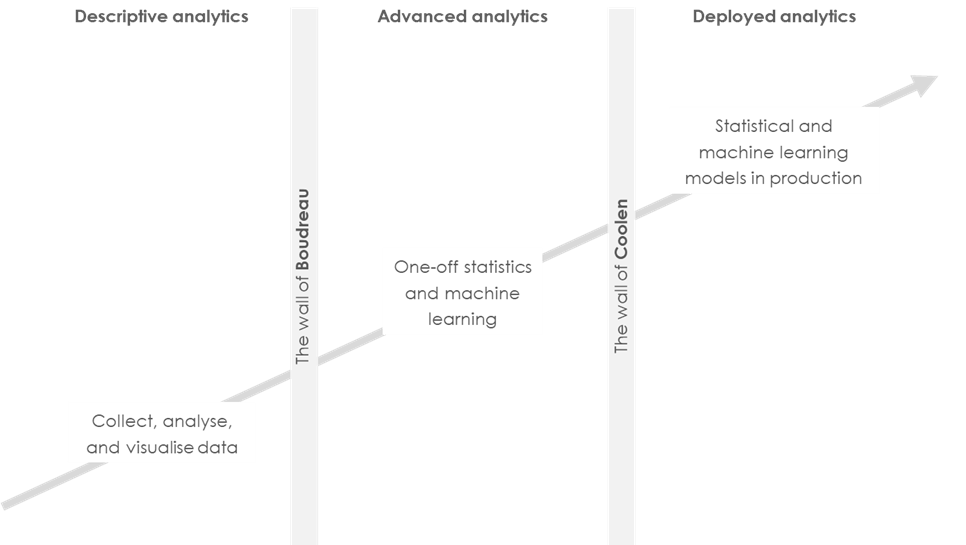
The second wall, however, represents a deeper transformation. It refers to the shift from isolated analytics projects to continuous, embedded intelligence integrated directly into organisational processes. In many organisations today, predictive models still exist as one-off projects. An attrition model might be built to answer a specific question, or a recruitment prediction might be developed as part of a temporary analytics initiative. The results often appear in reports or dashboards but rarely become part of everyday HR decision-making.
“When analytics is operationalised into functionality, it effectively turns analytics into AI-driven capabilities embedded in HR processes.”
Crossing the second wall means something fundamentally different. Predictive models are no longer occasional analyses but have become embedded capabilities within HR systems and processes. Machine learning models are deployed, monitored, and continuously updated as new data becomes available. They are integrated into the digital tools and platforms that managers and HR professionals use every day. In this way, insights move from static analysis toward continuously learning decision-support capabilities that operate at scale.
When analytics becomes operationalised or deployed in this way, it effectively turns advanced analytics into AI-driven capabilities embedded in HR processes. What many organisations today describe as AI in HR can therefore be understood as the operationalisation of people analytics beyond the second wall.
A more focused debate
Now that we have established a clearer definition of AI and recognise the direct connection between AI applications and the maturity of people analytics capabilities, the conversation about AI in HR can become more focused. The real question is no longer whether AI will impact HR. The more relevant question is how prepared organisations are to shape that impact.
The true competitive advantage in AI does not lie in access to tools. AI tools are becoming widely available. The real advantage lies in analytical capability, data maturity, and governance. These foundations allow organisations to deliberately design where human judgement remains in control and where AI supports or automates decisions.
Article by Patrick Coolen

Patrick Coolen is a true believer in making HR more evidence-based to improve decision-making. Over the past 15 years, he has established people analytics as a common practice within a large corporate organization. He has a proven track record in building various analytical services, ensuring their adoption within the organization, and enabling scarce analytical talents to grow in their roles. In addition to his specialism in people analytics, he was also part of the HR management team and is considered a seasoned and all-round HR executive. Patrick is an internationally recognized thought leader and a frequent speaker at HR and people analytics-related conferences. He is currently pursuing a Ph.D. focusing on the adoption and institutionalization of people analytics.