What leaders told us
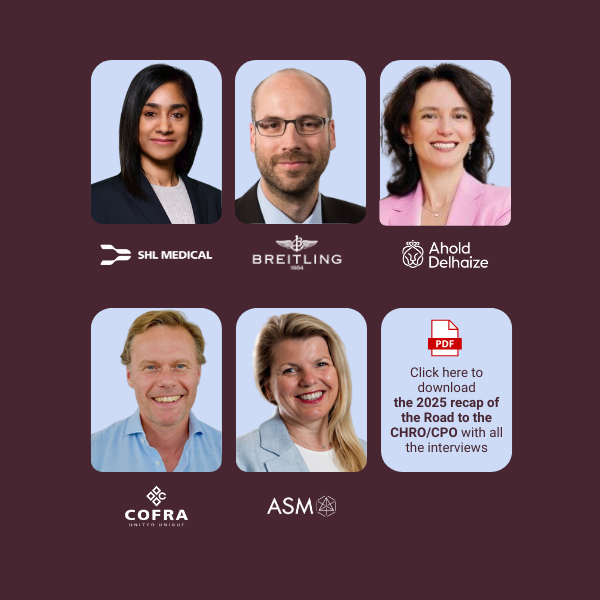
This year we sat down with five CHROs and people leaders from very different businesses: Breitling, Ahold Delhaize, ASM, COFRA and SHL Medical. We asked them one simple question:
‘What does it really take to sit in the CHRO seat today and have impact that matters?’
Behind the role title, one thing was crystal clear: the modern CHRO is a business leader first, an HR leader second. You are there to shape strategy, value creation and future leadership, with people, culture and organisation as your primary levers. As one of them put it: “If HR is seen as separate from the business, we are already on the back foot. The real work starts when the people strategy is the business strategy.”
A genuine thank you to the leaders who generously shared their time and perspective for this series: Natalia Wallenberg, Edyta Jakubek, Jeroen Wels, Mathieu Pointeau and Satbir Bains.
Download the 2025 Recap with all the interviews here (PDF)
What great CHROs actually do
1. Start with value, not with HR
The best CHROs think in P&L, customers and competitive dynamics, then in talent and organisation. One leader summed up their starting point as: “Know the P&L, know where value is created, then point your people agenda at those hotspots.” That mindset drives tough choices. What do we build in house, what do we automate, what do we stop doing, so that scarce HR capacity is always pointed at the work that moves the needle.
2. Wear three hats at once
Several interviewees described the future CHRO as sitting at the overlap of three roles:
- Chief People Officer: design, development, performance, leadership.
- Chief Operating Officer: where do we put our best people and leadership time.
- Chief Digital Officer: how do we use data, technology and AI to run this system at scale.
3. Shape culture with a spine, not slogans
Culture work shows up in hard decisions, not in posters. Do we keep the brilliant but toxic leader? What behaviours are genuinely non negotiable? How do we hold the ExCo to the same standards as everyone else?
One CHRO chose their current company because it was ready to “look at everything with a fresh pair of eyes” and do what is right for the business, not copy competitors. That kind of courage came up again and again.
The first 90 days: context over hero moves
None of the leaders arrived with a glossy “day one strategy”. In fact, they warned against it. A typical approach looked like this:
- Speak with the CEO, ExCo, business leaders, Works Council, key talent, even external partners.
- Ask what success would look like in three years, and what is getting in the way now.
- Be explicit that your first job is to understand the business, not to roll out a pre-packaged HR agenda.
One CHRO told colleagues early on:
“If I give you a full strategy in week two, you should worry. It means I have not yet understood your reality.”
Only after that discovery phase did they lock a small number of game-changing moves and start to reshape their core HR team around values, ethics and resilience, not just expertise.
Designing your road to the seat
There was no single career pattern, but two clear routes showed up repeatedly.
- The classic route: HR operations, then business partnering, then leading HR at business or regional level, and eventually the Group or Global role, always close to where money is made and strategy is set.
- The zig zag route: Rotating between CoEs and BP roles, moving from long-term design work to in-the-business execution, across different markets and business models, until you are ready for the full enterprise remit.
What mattered more than the sequence was the intent behind it.
The strongest signals from their advice:
- Say your ambition out loud. Sponsors cannot help if they do not know you want the CHRO seat.
- Touch every pillar of HR at some point, but develop a few deep spikes.
- Choose high growth, high change environments where HR co leads the business, not just runs processes.
- Volunteer for the messy, political, high risk problems. That is where your reputation is made.
The Human Reality behind the title
Every interview also surfaced the cost and the very human side of the role. Several leaders spoke about the loneliness of being the person who ultimately calls the shot on people, culture and sometimes jobs, and then lives with the consequences. A personal board of advisors, a small inner circle and a trusted team were mentioned as essential protective factors.
They also talked about the “shadow” of the role. Once you sit on the ExCo, your words and moods are amplified. An offhand remark can be heard as a decision, silence can be read as disapproval. That demands more conscious communication, without becoming fake.
Finally, they were unambiguous on one point: values fit is non-negotiable.“You have to stay very close to who you are and stand up for what you believe in. When you find the right place, you will know you can fly.”
If there is a single message for aspiring CHROs from these conversations it is this. Treat the role as a business job in disguise, build the muscles that sit at the intersection of people, operations and digital, and design your career with intent. The road to CHRO is demanding, but for those who choose it with open eyes, it is one of the most impactful seats in the enterprise.